
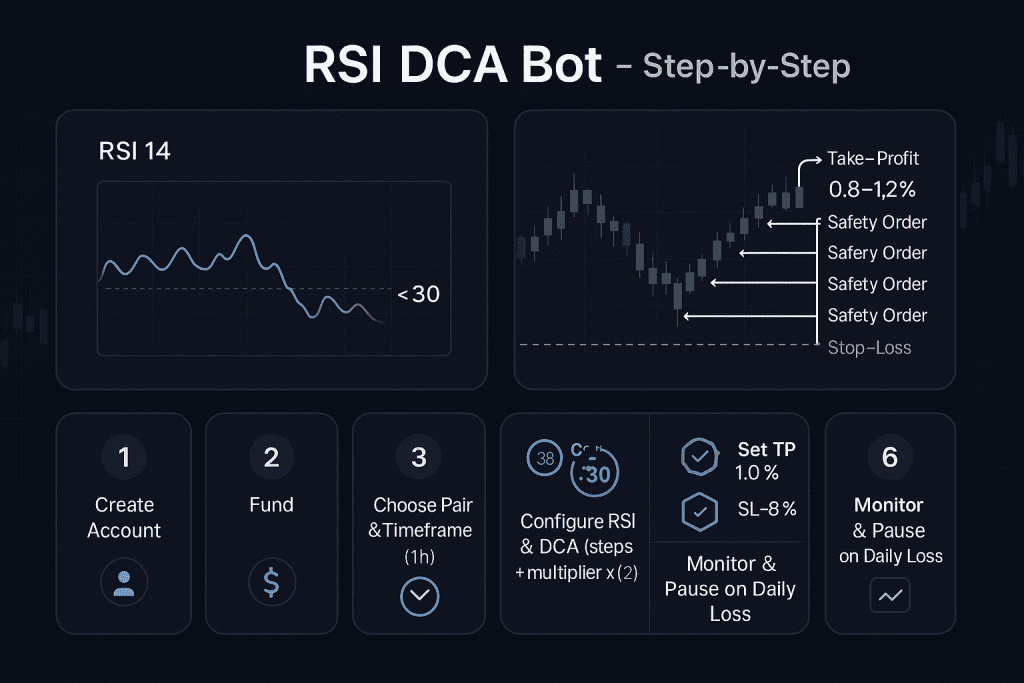
In this practical tutorial, you’ll configure an RSI DCA trading bot on BITGET. We’ll cover strategy logic, exact settings, allocation and safety orders, plus backtesting and monitoring so you can launch with confidence. If you’re exploring automated systems broadly, start here: Trading Bots — NextGenTrade Ltd.
Table of Contents
- What is an RSI DCA bot?
- Prerequisites & risk plan
- Step-by-step setup on BITGET
- Core parameters & recommended defaults
- Starter templates by account size
- Risk controls & allocation rules
- Backtesting, paper mode & go-live checks
- Daily/weekly monitoring routine
- Troubleshooting
- FAQ
1) What is an RSI DCA bot?
RSI DCA combines a momentum oscillator (Relative Strength Index) with dollar-cost averaging. The bot buys (or adds) when price is short-term oversold by RSI, spreads entries via base and safety orders, and exits on take-profit or when RSI normalizes. Compared to fixed-interval DCA, RSI gating reduces entries during strong uptrends or overheated downtrends and can improve average entry price.
2) Prerequisites & risk plan
- BITGET account with KYC + 2FA.
- Funding: USDT (spot) or margin (futures). Beginners: prefer spot.
- Pair selection: Liquid majors (BTC/USDT, ETH/USDT) to minimize slippage.
- Risk plan: Daily loss cap (3–5% equity), per-bot allocation cap, and max concurrent bots.
3) Step-by-step: Create an RSI DCA bot on BITGET
- Log in to BITGET, deposit/transfer USDT.
- Open the Bots section and choose Spot Grid/DCA (or the relevant DCA module).
- Select a trading pair (e.g., BTC/USDT) and timeframe for RSI (commonly 15m, 1h, or 4h).
- Enable RSI filter and set:
- RSI length: 14 (baseline; see alternatives below).
- Buy threshold: RSI < 32 (conservative), 30 (classic), or 28 (aggressive).
- Cooldown: 1–3 bars after an entry to avoid clustering.
- Configure orders:
- Base order size: initial buy (e.g., 1–3% of equity).
- Safety orders: number (3–6), spacing (e.g., every 1.5–3% drop), and multiplier (e.g., ×1–×1.5).
- Max position size: hard cap (e.g., 5–10% equity for one bot).
- Take-profit (TP) and exit:
- Static TP: 0.6–1.2% per cycle for majors; higher for alts.
- OR RSI exit: close when RSI >= 55–60 to capture mean reversion.
- Optional trailing TP: trail 0.3–0.5% after unrealized gain > 1%.
- Stop-loss (SL) / protection:
- Global SL (e.g., −6% to −10% from blended entry) to cap tail risk.
- Trading pause if daily loss cap hit.
- Review & launch in paper/sandbox if available, then go live with a small allocation and scale.
4) Core parameters & recommended defaults
| Parameter | Purpose | Conservative | Balanced | Aggressive |
|---|---|---|---|---|
| RSI Length | Sensitivity of the signal | 21 | 14 | 9 |
| RSI Buy | Oversold trigger | < 35 | < 30–32 | < 28 |
| Base Order | First entry size | ~1% equity | ~2% equity | ~3%+ equity |
| Safety Orders | DCA adds on dips | 3 @ 2.5% steps | 4–5 @ 2% steps | 6 @ 1.5% steps |
| SO Multiplier | Increase per add | ×1.0 | ×1.2 | ×1.5 |
| Take-Profit | Cycle exit | ~0.8% | ~1.0% | ~1.4% |
| Global SL | Fail-safe cap | −6% | −8% | −10% |
Tip: For trending markets, add an optional “only long above MA200” filter and widen RSI buy to reduce mean-reversion traps.
5) Starter templates by account size
Account 100–500 USDT (Spot)
- Pair: BTC/USDT
- RSI: 14; Buy < 30; Exit RSI ≥ 58 or TP 1.0%
- Base/Safety: 2 USDT base; 4 safety orders at 2% steps; multiplier ×1.2
- Max position: 10–20 USDT; Global SL: −8%
Account 500–2,000 USDT (Spot)
- Pair: BTC/USDT or ETH/USDT
- RSI: 14; Buy < 32; TP 0.8–1.2%; Exit RSI ≥ 60
- Base/Safety: 8–15 USDT base; 5 safety orders @ 2% steps; multiplier ×1.2
- Max position: 5–8% of equity; Global SL: −8%
Account 2,000–10,000 USDT+ (Spot or cautious Futures)
- Pair: BTC/USDT
- RSI: 14; Buy < 30; Exit RSI ≥ 58; optional trailing TP 0.4%
- Base/Safety: 0.5–1.0% equity base; 5–6 safety orders @ 1.8–2.2%
- Max position: 3–5% of equity; Global SL: −6% to −8%
For exchange comparisons and alternatives, see: Leading Crypto Exchanges.
6) Risk controls & allocation rules
- Per-bot cap: 3–8% of equity on majors; lower on alts.
- Concurrent bots: Start with one; add a second only after 2–4 weeks of stable results.
- Daily loss cap: Stop all bots for the day if reached (discipline matters more than settings).
- Trend filter: Optional MA200 or “no new entries during high-impact news” rule.
7) Backtesting, paper mode & go-live checks
- Backtest multiple RSI thresholds (28/30/32) and steps to find robust zones, not perfect curves.
- Paper test for 3–7 days: confirm entries, spacing, and exits match expectations.
- Go live small (e.g., 20–30% of the intended final allocation) and scale gradually.
8) Daily/weekly monitoring routine
Daily (5–10 minutes)
- Check open positions, blended entry price, and unrealized PnL.
- If volatility spikes, consider widening steps or pausing new entries.
Weekly (20–30 minutes)
- Review win rate per cycle, average hold time, and max adverse excursion.
- Tune RSI buy (±2 points) and safety step size (+/−0.5%) if cycles take too long or exits miss.
9) Troubleshooting
- Too many buys too quickly: Add a 1–3 bar cooldown and widen safety steps.
- Positions stuck for days: Raise exit RSI to 60–62 or enable small trailing TP.
- Drawdowns feel large: Lower max position cap and reduce safety order multiplier.
- High fees/slippage: Use majors and operate during liquid hours.
10) FAQ — Bitget RSI DCA Bot
What timeframe is best for the RSI?
Start with 1h or 4h to avoid noise. Move to 15m only if you can tolerate more cycles and smaller TP.
Which pairs work best?
BTC/USDT and ETH/USDT for liquidity and tighter spreads. Alts need wider steps and smaller allocation.
Can I run multiple bots?
Yes, but begin with one. Add the second after stable performance and keep a strict per-bot equity cap.
Is futures better than spot for RSI DCA?
Spot is safer for beginners. Futures amplify both returns and risk; use small leverage and stricter stops.
Disclaimer: This content is educational, not financial advice. Crypto trading involves significant risk. Only trade what you can afford to lose.